

Introduction
Usually, when creating a bank product, there isn’t a single large component that will significantly affect the price. Instead, it will likely be the combination of many small decisions that leads to a very high cost. Each of these decisions will need to relate to things like how many platforms you’d like to support, how many systems you’re integrating with these platforms, how strong your baseline for security is, how much visibility into operational activities you have, and finally, how many regulated user journeys are attached to the many seemingly simple screens on a mobile banking app. Therefore, lots of mobile banking app development budgets vary depending on the various types of projects.
So, founders or product leads don’t only try to get an estimate on the cost, but also aim to understand what types of decisions likely create costs, and what types of decisions likely create budget drift, but with no real business benefit. Here at Appricotsoft, we strive to develop these trade-offs early in the decision lifecycle. For us, the way we look at software is as we want to be very proud of what we build, honest in our approach, and make it very clear for our clients to make decisions based upon clear facts rather than just being able to guess about future events. This is also a key principle behind our Unison Framework that AI can help with executing the project’s objectives; however, all of the ownership of the project’s results, total accuracy of project quality, and accountability for the project’s results belong to the actual people associated with it.
Banking apps and regular apps are two different types of mobile applications when it comes to budget.
Typically, a consumer app can launch with a limited set of features, have a low level of backend complexity and adopt a “we’ll revisit security down the road” approach. A banking app, however, does not have this luxury.
Even for a modest mobile banking MVP, your app will require the following features to be considered truly functional: secure login access, account visibility, transaction history, notification system for customers using the service, device handling (i.e., using multiple devices), customer support options, multiple backend integrations and sufficient observability in order to investigate any incidents that occur during operations. Security and Auditability will not be something you will add later because they are fundamental requirements of the product. This is why app development pricing in the banking sector feels so high relative to apps with similar features in a retail/hospitality sector.
If you’re looking to start a budget for your banking app, please use the following readings as starting points to provide context around what’s necessary and what constitutes “normal” for each of these five features:
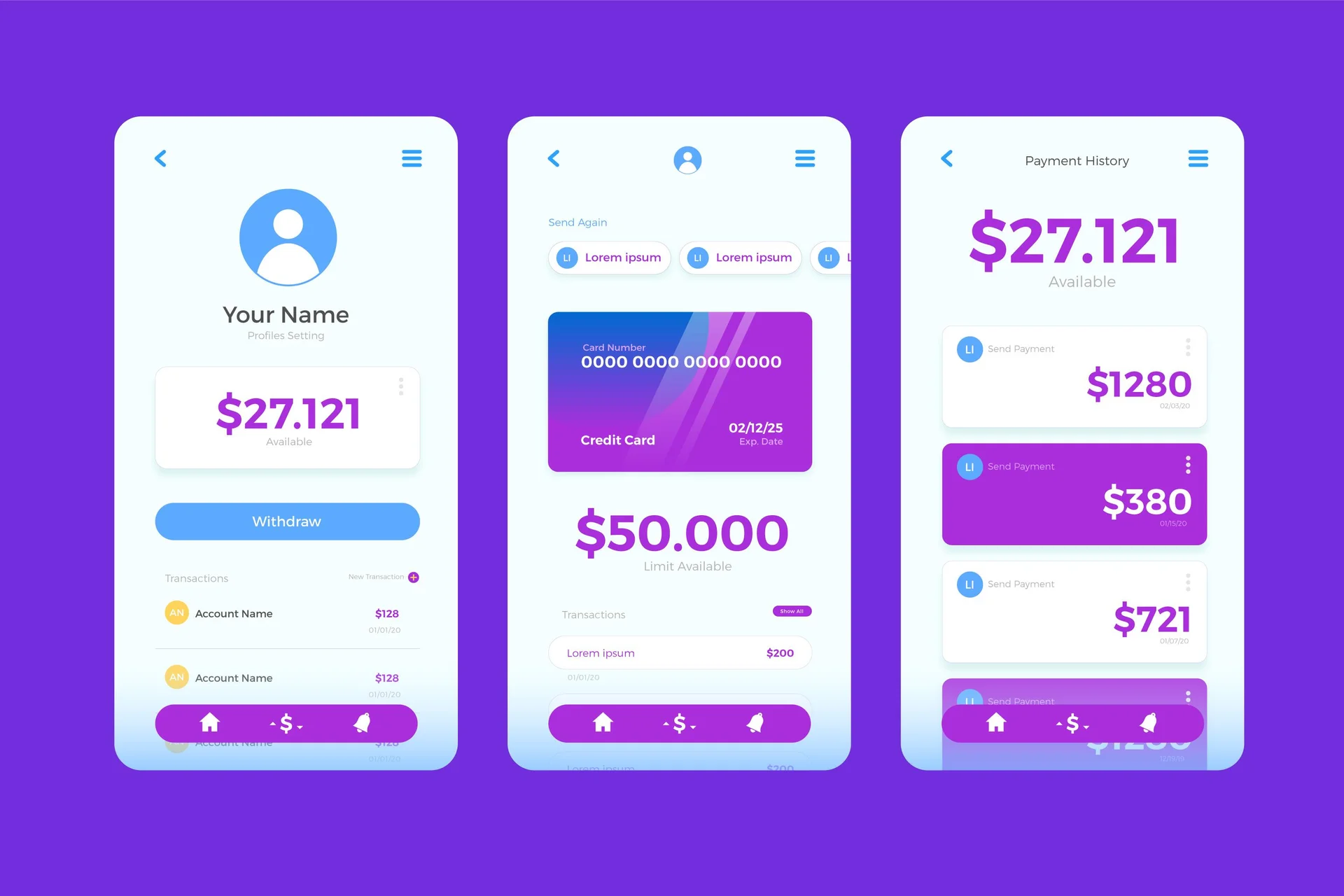
The 5 largest factors affecting the cost of mobile banking apps are:
1. Which Platform will be used: iOS and/or Android
The first lever for changing cost is the choice of platform to publish to.
An initial budget will naturally be lower for an iOS-only app or an Android-only app versus both operating systems; however, most banking-type products will actually need to support both from day 1 to give the customer the ability to use the product on any type of device, so this essentially is duplicating some of the work and only partially sharing the balance.
The real question when a company is trying to determine its app development costs is not going to be “are we going to go native or cross platform?”, but “what level of consistency, performance, and platform-specific quality levels are going to be necessary for our application?” An established iOS development company or an established Android development company will be able to provide objective information to consider in making those decisions. For some banking products, using a well-designed cross-platform strategy can reduce the cost of initial launching, and for some,e it will be best to use the native development for security reasons (the way the devices will securely store information), the method of using biometrics to authenticate users, restrictions from the SD, KS, and/or the performance level that is required.
Additional costs that will change if you go the route of both iOS and Android are:
- More coding and QA created for user interfaces
- A larger number of devices and operating systems are tested
- Release Management and support will require additional resources/overhead to manage successfully.
- More edge cases with biometrics, secure storage, permissions to access, and devices trusted by the application
This will not always mean double the development costs, but will most definitely be a sizeable increase in your development costs.
2. Integration Quantity and Complexity
Integrations are one of the largest hidden contributors to the costs associated with developing a mobile banking application.
Most banking applications do not stand alone and require the ability to integrate with various systems, including:
- Core Banking Systems
- Payment Processors
- Card Issuing/Management
- KYC, AML, etc.
- Fraud Detection
- Open Banking
- Notifications
- Customer Support/CRM
- Analytics
Each integration requires some form of implementation, mapping, testing, error state handling, retry options, reconciliation logic, and allows time for support with respect to the integration and the systems that they support. Additionally, weakly designed integrations can adversely affect operational costs after Go-Live (this is particular to the regulated industry), not just engineering costs before Go-Live.
According to Appricotsoft’s fintech roadmap, the growth of financial technology (i.e., fintech) depends on bringing these types of integrations into play at the right point in time – not just banging them together without other operational considerations.
Also, Appricotsoft indicated that monitoring for exposure to fraud typically starts with a less formal monitoring process that becomes more formalized over time.
To budget for the integration, the following questions need to be answered as part of the budget process:
- Is the partner’s API mature and or well documented?
- Does the partner provide a sandbox?
- Are there limits on throughput?
- How often is the partner’s API changed?
- Who is responsible for incident management when there is an incident due to an integration?
- Is a reconciliation required, or is there only a need for a real-time sync?
Having a simple integration to a stable API is one level of cost. Having or needing mission-critical banking integration is a completely different level of cost.
3. Baseline Related To Security And Compliance
Most of the time, security is not really thought of as a budget driver; it tends to be seen as a “technical overhead” rather than an integral part of the product being created.
In the banking sector, a baseline may contain the following items:
- Strong authentication and session management
- Secured device storage
- Data encryption while in transit and while resting/at rest
- API design with security controls
- Auditable logging
- Security secrets management
- Discipline around dependency and code review
- Release control processes
- Incident readiness
- Data handling with respect to privacy
OWASP’s Mobile Application Security Verification Standard (MASVS) discusses many of the control groups commonly referred to when considering mobile financial products. Multiple variables affect the true extent of security associated with a mobile financial product, but an appraisal of these four control groups demonstrates that the potential security surface area for mobile financial products is quite broad.
You won’t have to implement all of the advanced controls in your first release; however, you do need to create a baseline that is based upon what a rational person would perceive to be necessary. In the article by Appricotsoft on security within a Secure Software Development Life Cycle (SDLC), it is stated that “In fintech, security cannot be an afterthought post-launch; creating something and requiring 100% rework is extraordinarily costly” once there is real user data, real money, and real compliance risk.
One area where founders often underestimate the total budgeted amount of funding is comparing feature sets that they are seeking from two different vendor partners; however, one price listing includes significant security control,s while the other implicitly assumes that their security controls were included within their projected price.
4. Feature Depth: Specifically, Transfers, P2P, Cards, and Support Flow
The name of a feature may not be correct.
The word “transfers” makes it sound like it is one feature, but it actually could include:
- Own account transfers
- Internal account transfers
- Domestic bank transfers
- International bank transfers
- Scheduled transfers
- Recurring transfers
- Beneficiary management for transfers
- Transfer confirmation flows
- Transfer limits and approvals
- Transfer failure handling and reversal support
As with P2P transactions, if you are trying to get true P2P transactions, you may have to add additional functionality such as:
- Contact discovery
- Recipient verification
- Anti-fraud checks
- Transfer states
- Ledger management
- Notification logic for transfers
- Dispute management
- Completion/failure analytics
This will increase the cost of developing the feature from a “nice to have” to possibly a major cost driver.
The more money your product makes through money movement features, the more product, technical, operational, and compliance complexity is behind the feature. Therefore, the price of custom mobile application development for banking products is based on a combination of the risk associated with the business and the complexity of the process, not just how the screens are designed.
5. Analytics is mostly placed toward the end of the roadmap
Why would you want analytics for product learning? Of course, you do. But you also require operational visibility for a variety of categories,s including:
- Funnel drop off in KYC or onboarding
- Failed logins and suspicious behaviour
- Failed transfers
- Vendor issues
- Notification delivery failures
- Support correlation
- Monitoring release quality
There is also more than just the “add Mixpanel” or “Add dashboards” here. There is the design of an event model (what to track vs. not track), data privacy, business reporting aligning to ops decisions, and so on.
This has never been more important than it is right now. Financial services are also under a more defined expectation from consumers regarding the control of their own data, privacy, and responsible usage of data. The CFPB’s 2024 Personal Financial Data Rights rule, which puts a greater focus on consumer rights, privacy,cy and security with regard to financial data access and sharing, serves as another reminder that fintech data practices should be thoughtfully developed instead of relying on improvised practices down the road.
A cost model that can be easily adapted
The following is a very straightforward ‘conceptual’ example of a model we use when talking about initial budgeting. It does not represent a common pricing model but provides a base-level framework for founders to compare alternatives.
Total Cost = Base Product + Platform Multiplier + Integration Load + Security/Compliance Layer + Functionality Level + QA/Release Scope + Analytics/Operations + Contingent
Let’s describe what each of these terms means.
Base Product
This is your core delivery platform and includes the components for discovery and planning, UX/UI design, backend setup, mobile shell, invoice app-shell, security authentication setup, account information screens, project management, QA baseline/process, and release preparation.
Think of this as the absolute minimum you will need to build a functional, real bank product(i.e., not a clickable prototype).
Platform Multiplier
To arrive at the Platform Multiplier, one must multiply the Base Product cost by a Platform Multiplier based on:
- Single vs Multi-platform
- Native vs cross-platform
- Device Coverage
- Accessibility and localization
If the aim is to keep costs under control, one platform MVP may be an option to consider. However, if you choose to release on multiple platforms, be prepared for significantly more initial development and QA costs.
Integration Load: To determine the Integration Load, you want to create a scoring mechanism for each integration based on the difficulty of creating that integration.
Low – Stable API; clear documentation; clear data flow
Medium – Multiple endpoints; business rules; retries; some vendor friction
High – Limited documentation; data reconciliation; possible compliance implications; possible operational dependencies
After defining the score for your integration, calculate the number of integrations you have that fall into the low, medium, and high groups. This is usually more accurate than describing the number of integrations (ex,5 integrations).
Feature Complexity
Group features into:
- Foundation: login, accounts, history, notifications, settings
- Growth: cards, transfers, support, statements, limits
- Advanced: P2P, external payments, open banking connectivity, fraud tooling, admin workflows
This helps you sequence costs instead of swallowing everything at once.
QA and Release Scope
Budget depends on:
- Manual test coverage
- Regression expectations
- Device matrix
- Sandbox testing
- Security verification
- Release gates and rollback readiness
In finance, weak QA usually becomes expensive twice: once during launch chaos and again during credibility repair.
Analytics and Operations
Include:
- Product analytics implementation
- Event taxonomy
- Dashboards
- Alerting
- Error monitoring
- Admin reporting
- Support investigation tooling
Contingency
For banking products, a contingency reserve is healthy because costs can move due to vendor delays, policy changes, compliance findings, or late product decisions.
A simple example using the model
Imagine a founder wants:
- iOS and Android
- Secure auth and account view
- Transactions and notifications
- Card management
- One KYC vendor
- One payment/vendor integration
- Basic analytics
- No P2P in phase one
That is not a “small app,” but it is still a focused first release. The budget would likely be driven mostly by dual-platform support, two key integrations, security baseline, and QA coverage.
Now compare that with a second version that adds:
- P2P payments
- Open banking connectivity
- More advanced fraud controls
- Deeper support tooling
- More analytics and reporting
The visible UI might only grow by 20 to 30 percent, but the cost can grow much faster because the operational and compliance surface expands.
That is why the best mobile app development company conversations focus on architecture, vendor choices, and control points early, not only on design screens.
How to Cut Costs While Keeping Trust Intact
To save money in banking, the goal is to improve quality but do so in the right order.
Here are some examples of how to manage a budget:
Start with a single, clearly defined task
A Banking Minimum Viable Product (MVP), or first phase of a digital transformation project, should not be an attempt at a “full digital bank.” It should only address one important customer need with an appropriate trust baseline.
Determine the necessary integrations for phase 1.
Some of the integrations will allow you to deliver the product to customers,s and others can wait until you have sufficient traction or business impact to justify implementing them.
Establish a foundation that can scale.
The architecture and security framework should support future features, es but only the features required at this time should be built.
Quantify the costs of security in the estimate.
Security should be included, and information should not be buried under vague line items related to engineering.
Utilize weekly showcases and decision logs.
Using a framework such as Unison could provide additional value through undeniable progress, well-defined trade-offs, and fewer unforeseen expenses.
Reject false certainty.
Providing a precise estimate produced from imprecise assumptions is far less beneficial than developing a structured estimate using well-defined ranges with openness.
How Cost Planning for Banking Apps is Handled at Appricotsoft
Appricotsoft maintains a cost planning approach based on reality.
We will not use estimation as a sales tactic; we want to understand how your product fits together, where the actual complexity lies, and how changes before delivery affect budgets. This is consistent with our core values of honesty, accountability, quality, and a commitment to continuous learning rather than pretending we know it all.
We’ve learned through our experience in developing startup products, client-facing platforms, and AI-first delivery models that when teams use one source of truth, they can be more productive. Thus, Unison emphasizes creating distinct phases within the project, acceptance criteria visible to everyone, and risk visibility through regular demo processes and quality control standards integrated into the delivery, so all of these elements can be part of the overall project and not just at the end.
Since the development of mobile applications is usually a challenging process for founders assessing application development, this usually results in the following better estimation processes:
- clearer scope boundaries
- fewer hidden assumptions
- more honest trade-off discussions
- a roadmap you can change as your business evolves.
Conclusion
Most of the factors that have the biggest influence on the mobile banking app development cost will never be obvious from looking at a product pitch. They are hidden within the product and include things like the number of platforms supported, the number and complexity of integrations, the security and compliance foundation, the level of money moving capabilities, and required analytics and operational controls.
And it is a good thing that those are some of the most important determinants of cost because it means you can control your budget by focusing on the right decisions.
Once you know what drives the costs of building the product you are designing, you will be able to plan your development roadmap wisely, keep the critical areas of the product safe from any potential risks, and skip unnecessary complexities that you may not really need yet. Moreover, working with an honest development team will ensure that estimation turns into your strategic advantage.
At Appricotsoft, we specialize in making sure our clients have a clear picture of what drives their mobile app development cost, especially in the case of banking or fintech projects. We enjoy delivering quality software, but we love the process almost equally.