

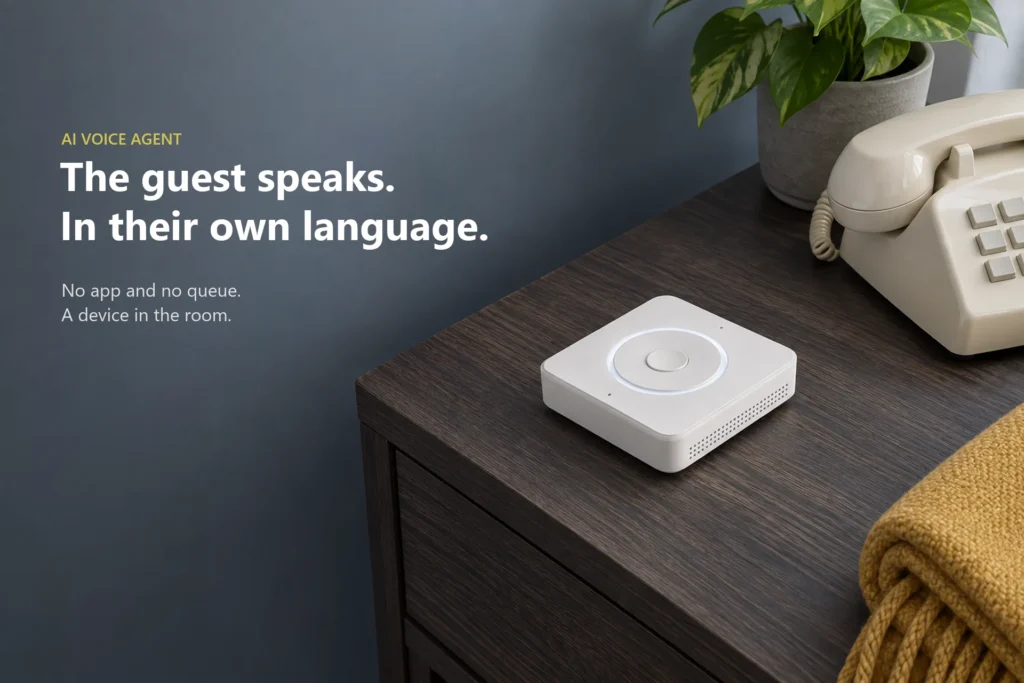
An AI voice agent is not a microphone with a language model behind it. It is a chain. Capture speech, work out the request, decide where it belongs, hand it to a system that can answer or act. Most voice projects fail at the last link, not the first. The speech part works, and then the request has nowhere to go. Here is what that chain looks like end to end, and where the real decisions sit.
Why voice, when an app already exists
Service businesses usually try the obvious channels first. A phone line, then an app, sometimes both. Adoption stays low, and people blame laziness or bad UI. That is rarely the whole story.
A phone line asks the person to speak a language they may not be comfortable in. To a stranger. Possibly after a wait. An app asks them to download something, create an account, and learn a layout for one request. Both put work on the person before they get anything back. Voice removes that work. They say what they want, in their own words, and something happens.
That is the case for a conversational ai agent in a service setting. Not novelty, but a shorter path from intent to outcome. It also explains where ai voice agents for business land best: places where the request is short and the person is not a repeat user. A hotel room, a clinic waiting area, a facility floor. Nobody builds a habit around an interface they use twice.
The trade-off is that voice is unforgiving. A button either works or it doesn’t. A voice ai agent can hear you, understand you, and still do nothing useful. The person has no idea which part broke. That puts the burden on everything behind the microphone.
How an ai voice agent works, layer by layer
Four layers, in order. Each one can sink the product on its own.
| Layer | What it does | What breaks it |
|---|---|---|
| Wake and capture | Wake word or button starts the session and captures clean audio | Background noise, far-field microphones, false triggers |
| Speech recognition | Turns audio into text, ideally in the speaker’s own language | Accents, code-switching, unfamiliar domain vocabulary |
| Intent classification | Turns text into a typed request the system can route | Overlapping intents, requests that are two things at once |
| Fulfilment | Answers from a knowledge base, or routes to someone who acts | No system of record behind it, so nothing happens |
Wake and capture
You need a deliberate start signal. A wake word feels natural but fires on things it shouldn’t. A physical button never misfires, but it has to sit within reach. In practice you want both, because different people reach for different ones.
This layer also takes the most damage from background noise. A room with a television on poses a different acoustic problem than a quiet office. That is a hardware problem before it is a software one.
Speech recognition
Accuracy here is not one number. It varies by language, by accent, and by how much domain vocabulary you throw at it. Recognition will work worse for some of your users than for others. The design has to survive that rather than assume it away.
Intent classification
This is where most of the product lives. You are not trying to understand everything a person might say. You are sorting what they said into a small number of types your system knows how to handle. A tight set of intents you handle well beats a broad set you handle unevenly.
Anything outside the set needs an honest fallback. Say you did not get it, offer to pass it to a person, and do not guess.
Fulfilment
A request that lands and then goes nowhere is worse than one you never captured. The person believes it arrived. Information requests resolve against a knowledge base. Action requests go to a routing engine, which turns them into a ticket with an owner and a response time.
We have written about that side separately. How guest requests reach the right team covers classification, assignment and escalation, and the same structure holds whether the request arrived by voice, chat, or a form.
Latency ties all four together
Text chat tolerates a pause. Speech does not. Stretch the gap between the end of a sentence and the start of a reply, and people repeat themselves, talk over the agent, or assume it broke. Budget latency across the whole chain from day one. You cannot retrofit it once the architecture sets.
Example from our practice: ButlerIQ
Butler, a British startup, came to us with a problem that is easy to state and hard to fix. The phone in the hotel room was, in practice, dead. Not broken. Unused.
A guest will not pick it up to speak an unfamiliar language to a stranger. They do not want to wait on the line. And they will not ask a second time if the first attempt went nowhere. Three separate barriers, each small enough to ignore alone and fatal together.
Not an app, a device in the room
The answer was not another app. We built a physical voice device for the room. The guest says “Hey Butler” or presses a button, and speaks in their own language. No download, no account, no learning curve. Nobody on the other end to feel awkward with.
Three request types, on purpose
Every request falls into one of three types:
- Information — answered straight from the hotel’s knowledge base: checkout time, breakfast hours, how the air conditioning works.
- Local recommendations — restaurants, transport, what is worth doing nearby.
- Action — anything that needs a human or a system: towels, maintenance, a booking.
Three types is a deliberate constraint. Small enough that classification stays reliable and each path gets built properly. Broad enough to cover what guests actually ask.
Choosing the hardware was a product decision
Appricotsoft owned the architecture, the hardware, the AI stack, and delivery — including the choice of the devices themselves. That last part deserves calling out, because teams usually treat it as procurement. It isn’t.
In a voice product, the device sets how far away someone can stand and still get heard. It sets how the agent behaves with a television on in the background. It sets what the wake word can realistically be, and what happens to audio before it leaves the room. Choosing it constrains everything above it. Pick the hardware after you design the software, and you discover your latency and noise assumptions were wrong at the worst possible moment.
The full story sits in the ButlerIQ ai concierge case study.
The general lesson: voice won here not because it was the modern option, but because it removed language, the queue, and the awkwardness in one move. If a channel only removes one of those, the old one usually survives.
What to get right before you ship
Treat languages as a product requirement
Being multilingual is the reason the channel works at all. If the person still has to switch languages to get understood, you have rebuilt the phone line with extra steps. Native language support belongs in the architecture from the first design session. We made the same argument about multi-language support in hotel products: you do not bolt it on before launch.
Test in the real acoustic environment
A quiet office is not a hotel room, a clinic reception, or a shop floor. Background noise, distance from the device, and hard surfaces all change your recognition results. Find that out during the pilot, not after the rollout.
Design the fallback before the happy path
Every voice agent will hit requests it cannot handle. What it does then decides whether people come back. Admitting the miss and offering a human keeps you in the game. Confidently doing the wrong thing does not.
Decide the privacy position early
A device with a microphone in a private space raises a fair question. When is it listening, and what do you keep? Whatever your answer, make it a deliberate decision — one that holds up to a regulator and reads clearly to the person in the room.
Roll out narrowly first
One floor, one site, one department. A voice agent produces a stream of things people actually said. That stream is the best specification you will get for what to build next. Scale before you read it, and you scale the wrong intent set.
Choose the channel honestly
A phone line reuses hardware but keeps the language and queue barriers. An app gives you a screen but demands a download. A dedicated device costs more up front and removes the most friction. An ai receptionist on a phone line and a voice device in a room are different products with different adoption curves. Pick based on where the friction actually sits for your users.
Conclusion
An ai voice agent lives or dies on what happens after someone speaks. Speech recognition is a solved-enough problem. The work sits in intent classification narrow enough to stay reliable, a knowledge base worth answering from, a routing engine that turns the rest into tickets someone owns, and hardware that matches the room.
The channel earns adoption when it removes more than one barrier at once: language, waiting, and the discomfort of asking again. If you are weighing voice as a channel, our AI solutions practice covers the architecture, the stack, and the device side together. Separating them is how these projects go wrong.